

Multiple Systems in T2D
T2D is driven by several pathophysiological defects, many of which can now be addressed with available therapies that enable individualizing treatment1,2
Multisystem Contributors Are Associated With Hyperglycemia and the Progression of T2D1,2
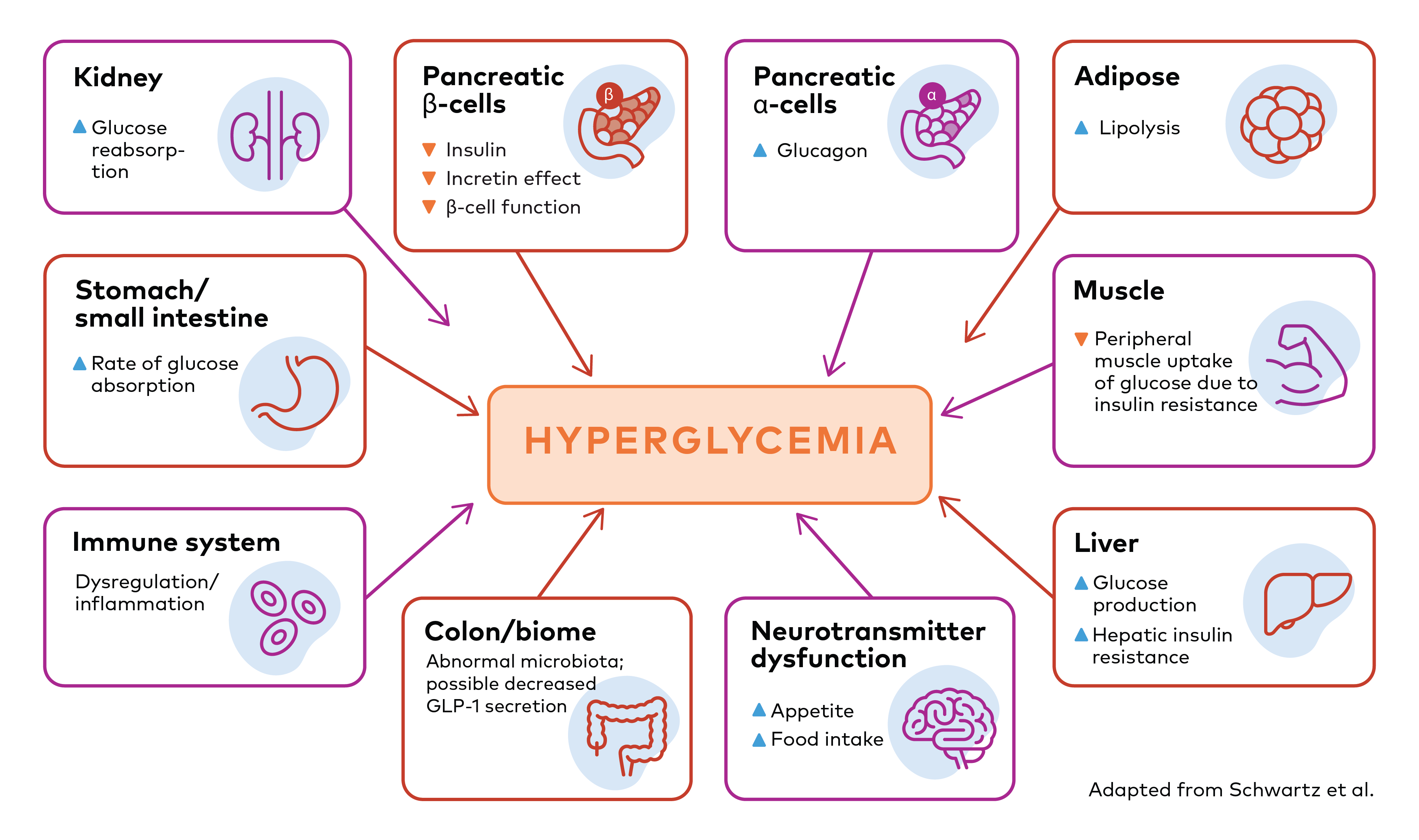
The graphic shows which processes in different organ systems can contribute to the development of hyperglycemia. In the kidney: Increased reabsorption of glucose. In the stomach/small intestine: Increased glucose uptake. At the level of the immune system: Dysregulation or inflammation. In the colon/microbiome: Abnormal microbiota, possibly reduced secretion of GLP-1. Dysfunction of neurotransmitters: Increased appetite and food intake. In the liver: Increased glucose production and hepatic insulin resistance. In the muscle: Reduced uptake of glucose into the peripheral muscle due to insulin resistance. In adipose tissue: Increased lipolysis. In the α-cells of the pancreas: Increased glucagon production. In the β-cells of the pancreas: Reduction in insulin production, reduction in the incretin effect and loss of cell mass of the β-cells.
Many different systems contribute to hyperglycemia directly and indirectly. Excess adipose is an important contributor.3 It is important to consider that many of these changes may begin years before a person is diagnosed and continue to worsen unless modified by specific medical intervention.3-9
Medications have unique roles in modifying the metabolic mechanisms that drive T2D progression2,10,11
Medications treat core defects of T2D differently across classes, with some medications treating more core defects than others1,2,10,11
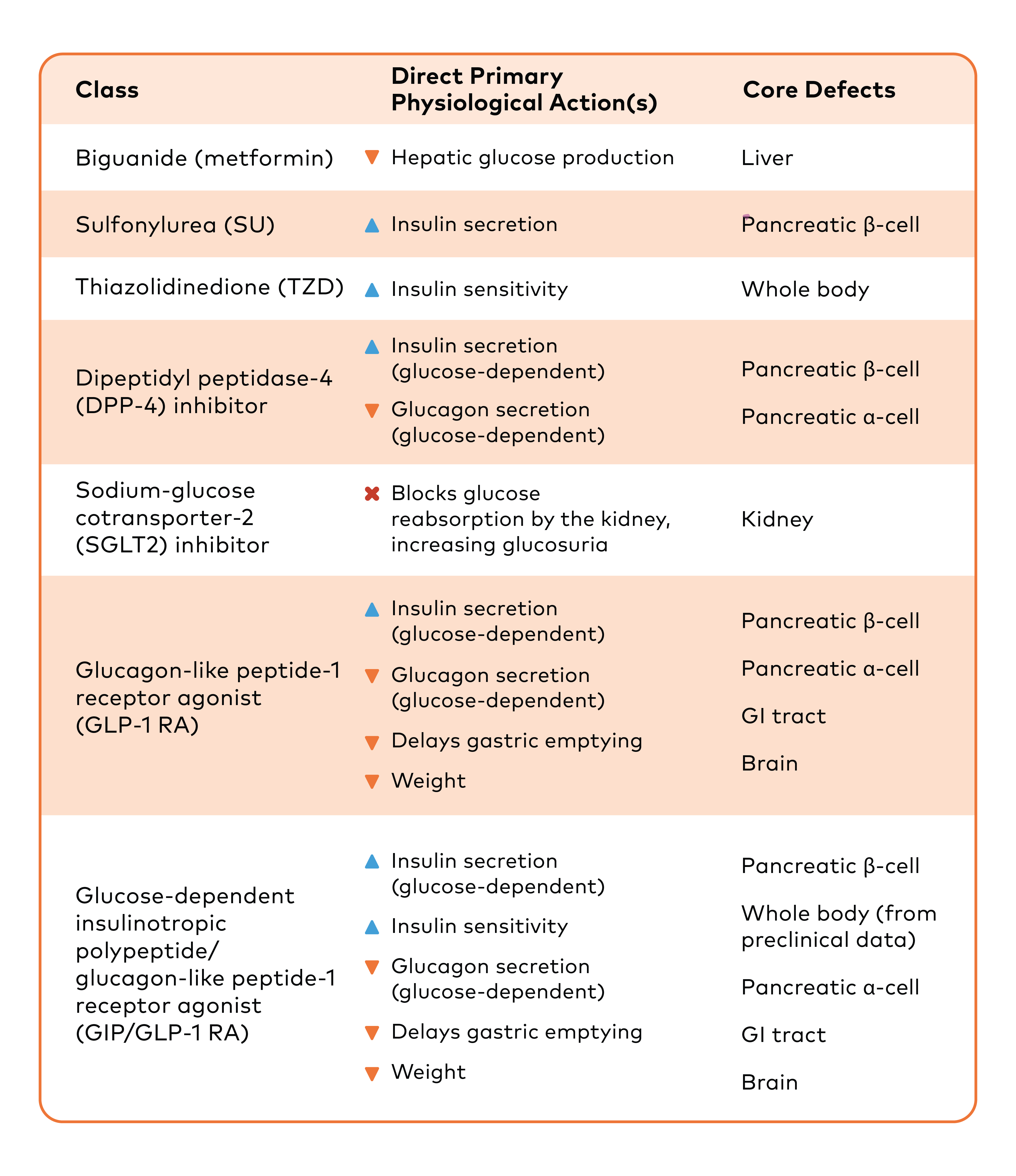
| Class | Direct Primary Physiological Action(s) | Core Defects |
|---|---|---|
| Biguanide (metformin) | Reduces hepatic glucose production | Liver |
| Sulfonylurea (SU) | Increases insulin secretion | Pancreatic β-cell |
| Thiazolidinedione (TZD) | Increases insulin sensitivity | Whole body |
| Dipeptidyl peptidase-4 (DPP-4) inhibitor |
|
|
| Sodium-glucose contransporter-2 (SGLT2) inhibitor | Blocks glucose reabsorption by the kidney, increasing glucosuria | Kidney |
| Glucagon-like peptide-1 receptor agonist (GLP-1 RA) |
|
|
| Glucose-dependent insulinotropic polypeptide/glucagon-like peptide-1 receptor agonist (GIP/GLP-1 RA) |
|
|
The schematic is intended to provide an overview of T2D drugs and is not specific to only 1 product within each class listed. It is not limited to making any expressed or implied comparison among products. The classes shown are from the ADA Standards of Care and do not represent all T2D classes available to treat hyperglycemia.

Which class would you choose for a patient like Rahul?
Rahul is showing signs of multiple core defects of T2D, including insulin resistance and excess adiposity, based on his elevated HbA1c and waist-to-hip ratio. Most urgently, these defects tend to be progressive and indicate that Rahul is likely experiencing an ongoing decline in his β-cell function.1,2

Medications with the ability to address multiple defects, including excess adiposity, enable more comprehensive and effective T2D management.1
Schwartz SS, Epstein S, Corkey BE, et al. The time is right for a new classification system for diabetes: rationale and implications of the β-cell-centric classification schema. Diabetes Care. 2016;39(2):179-186. doi:10.2337/dc15-1585
DeFronzo RA. Banting Lecture. From the triumvirate to the ominous octet: a new paradigm for the treatment of type 2 diabetes mellitus. Diabetes. 2009;58(4):773-795. doi:10.2337/db09-9028
Chait A, den Hartigh LJ. Adipose tissue distribution, inflammation and its metabolic consequences, including diabetes and cardiovascular disease. Front Cardiovasc Med. 2020;7:22. doi:10.3389/fcvm.2020.00022
de Luca C, Olefsky JM. Inflammation and insulin resistance. FEBS Lett. 2008;582(1):97-105. doi:10.1016/j.febslet.2007.11.057
Xu H, Barnes GT, Yang Q, et al. Chronic inflammation in fat plays a crucial role in the development of obesity-related insulin resistance. J Clin Invest. 2003;112(12):1821-1830. doi:10.1172/JCI19451
Trouwborst I, Bowser SM, Goossens GH, Blaak EE. Ectopic fat accumulation in distinct insulin resistant phenotypes; targets for personalized nutritional interventions. Front Nutr. 2018;5:77. doi:10.3389/fnut.2018.00077
Raji A, Seely EW, Arky RA, Simonson DC. Body fat distribution and insulin resistance in healthy Asian Indians and Caucasians. J Clin Endocrinol Metab. 2001;86(11):5366-5371. doi:10.1210/jcem.86.11.7992
Kozawa J, Shimomura I. Ectopic fat accumulation in pancreas and heart. J Clin Med. 2021;10(6):1326. doi:10.3390/jcm10061326
Ye R, Onodera T, Scherer PE. Lipotoxicity and β cell maintenance in obesity and type 2 diabetes. J Endocr Soc. 2019;3(3):617-631. doi:10.1210/js.2018-00372
Inzucchi SE, Bergenstal RM, Buse JB, et al. Management of hyperglycemia in type 2 diabetes, 2015: a patient-centered approach: update to a position statement of the American Diabetes Association and the European Association for the Study of Diabetes. Diabetes Care. 2015;38(1):140-149. doi:10.2337/dc14-2441
Mounjaro (tirzepatide once weekly) India Prescribing Information | Updated Sep 2024