
Addressing
Obesity
in the Clinic
Treatment Modalities
Lifestyle changes, psychological interventions, pharmacological management, and bariatric surgery are the key treatment modalities for obesity.1-3
Lifestyle Modification2,4
Medical nutrition therapy:
- Long-term adherence to a healthy eating pattern that is personalized to meet individual values and preferences
Increased exercise:
- At least 150 minutes of physical activity per week
Pharmacotherapy (approved in India)5-7
| Name | Class | Year approved |
|---|---|---|
| Orlistat | Pancreatic lipase inhibitor | 1999 |
| Semaglutide (sc) | GLP-1 receptor agonist | 2021 |
| Tirzepatide | GIP/GLP-1 receptor agonist | 2024 |
Bariatric Surgery2 can be considered for people with
- BMI of ≥40 kg/m2 or
- BMI of ≥35 kg/m2 with at least 1 adiposity-related disease (level 4, grade D, consensus)
- Bariatric surgery should be considered in patients with poorly controlled type 2 diabetes and class I obesity (BMI between 30 and 35 kg/m2) despite optimal medical management. (Level 1a, grade A)
- Bariatric surgery may be considered for weight loss and/or to control adiposity-related diseases in persons with class 1 obesity, in whom optimal medical and behavioral management has been insufficient to produce significant weight loss. (Level 2a, grade B)
Effective partnership is essential for long-term success2
The “5 As” model can help you discuss weight management with your patients8
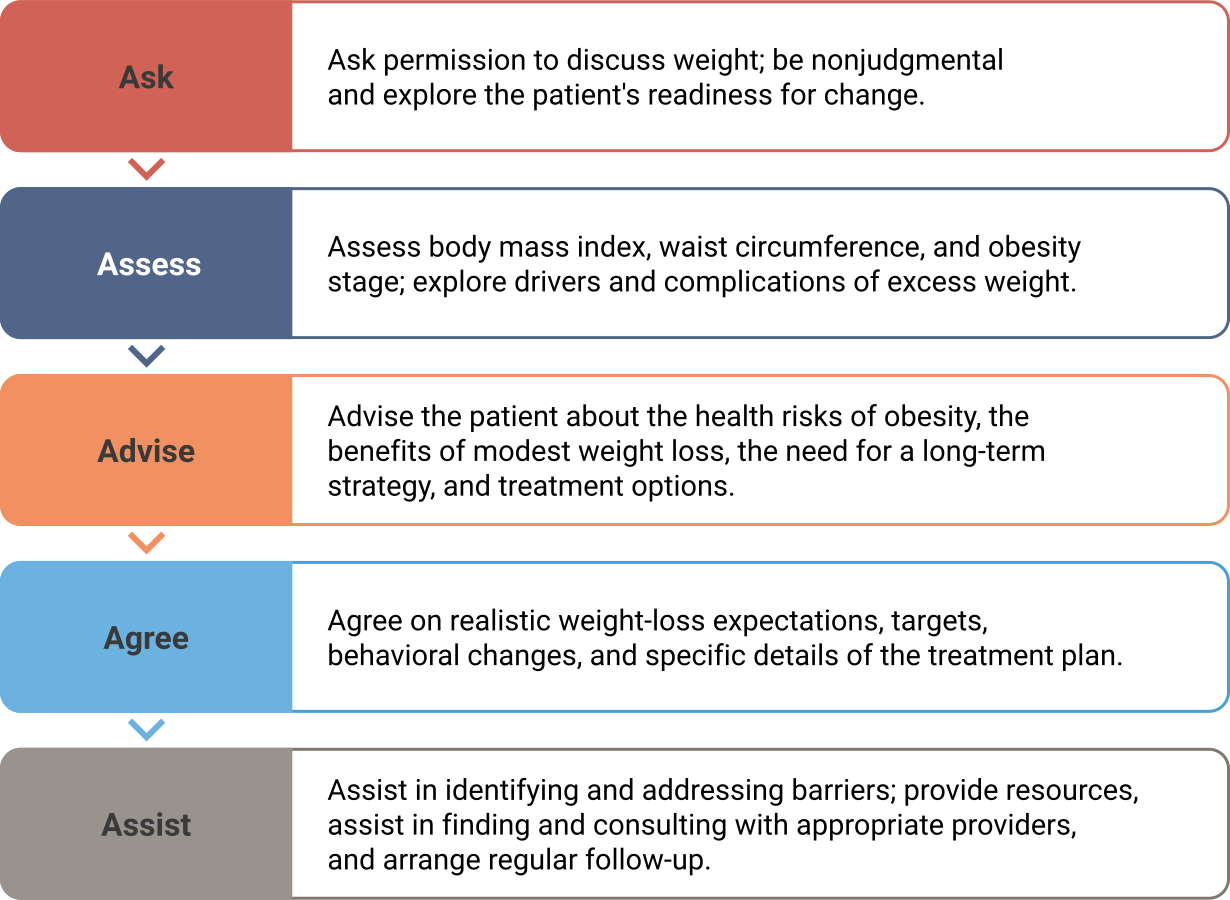
The graphic shows a conversation flow based on the "5A" model. The "5A" model is an easily implemented evidence-based and behavior-oriented intervention strategy. It can help to increase the success of weight management in primary care. 6
- Ask: Ask for permission. Ask patients for permission to talk about body weight together. Don't judge and explore readiness for change.
- Assess: Assess the current situation. Measure BMI, waist circumference and degree of obesity. Record possible causes and complications caused by excess weight.
- Advise: Educate and advise patients about the health risks of obesity and the benefits of moderate weight loss and advise them on long-term strategies and treatment options.
- Agree: Agree on specific goals. Talk to patients about realistic expectations. Agree on realistic goals for weight loss, behavior change, and other details of the treatment plan.
- Assist: Support. Identify and address potential obstacles. Provide information, support in finding suitable co-treatment partners and arrange regular follow-up appointments.
Find important information on treatment modalities for obesity
Garvey WT, Mechanick JI, Brett EM, et al. American Association of Clinical Endocrinologists and American College of Endocrinology comprehensive clinical practice guidelines for medical care of patients with obesity. Endocr Pract. 2016;22(suppl 3):1-203. doi:10.4158/EP161365.GL
Wharton S, Lau DCW, Vallis M, et al. Obesity in adults: a clinical practice guideline. CMAJ. 2020;192(31):E875-E891. doi:10.1503/cmaj.191707
Ruban A, Stoenchev K, Ashrafian H, Teare J. Current treatments for obesity. Clin Med (Lond). 2019;19(3):205-212. doi:10.7861/clinmedicine.19-3-205
Jastreboff AM, Aronne LJ, Ahmad NN, et al. Tirzepatide once weekly for the treatment of obesity. N Engl J Med. 2022;387(3):205-216. doi:10.1056/NEJMoa2206038
Garvey WT. New horizons. A new paradigm for treating to target with second-generation obesity medications. J Clin Endocrinol Metab. 2022;107(4):e1339-e1347. doi:10.1210/clinem/dgab848
Bersoux S, Byun TH, Chaliki SS, Poole KG. Pharmacotherapy for obesity: what you need to know. Cleve Clin J Med. 2017;84(12):951-958. doi:10.3949/ccjm.84a.16094
Mounjaro (tirzepatide once weekly) India Prescribing Information Sept 2024.
Vallis M, Piccinini-Vallis H, Sharma AM, Freedhoff Y. Clinical review: modified 5 As: minimal intervention for obesity counseling in primary care. Can Fam Physician. 2013;59(1):27-31.