

Long-term Benefits of Early Control of T2D
In the UKPDS, long-term benefits of early T2D control have been well described1,2,3||
Results demonstrated a Legacy Effect, in which intensive glycemic control from the time of diagnosis had a significantly greater impact on clinical outcomes than delayed control2,3
Legacy Effect of Intensive Glucose Lowering2,3
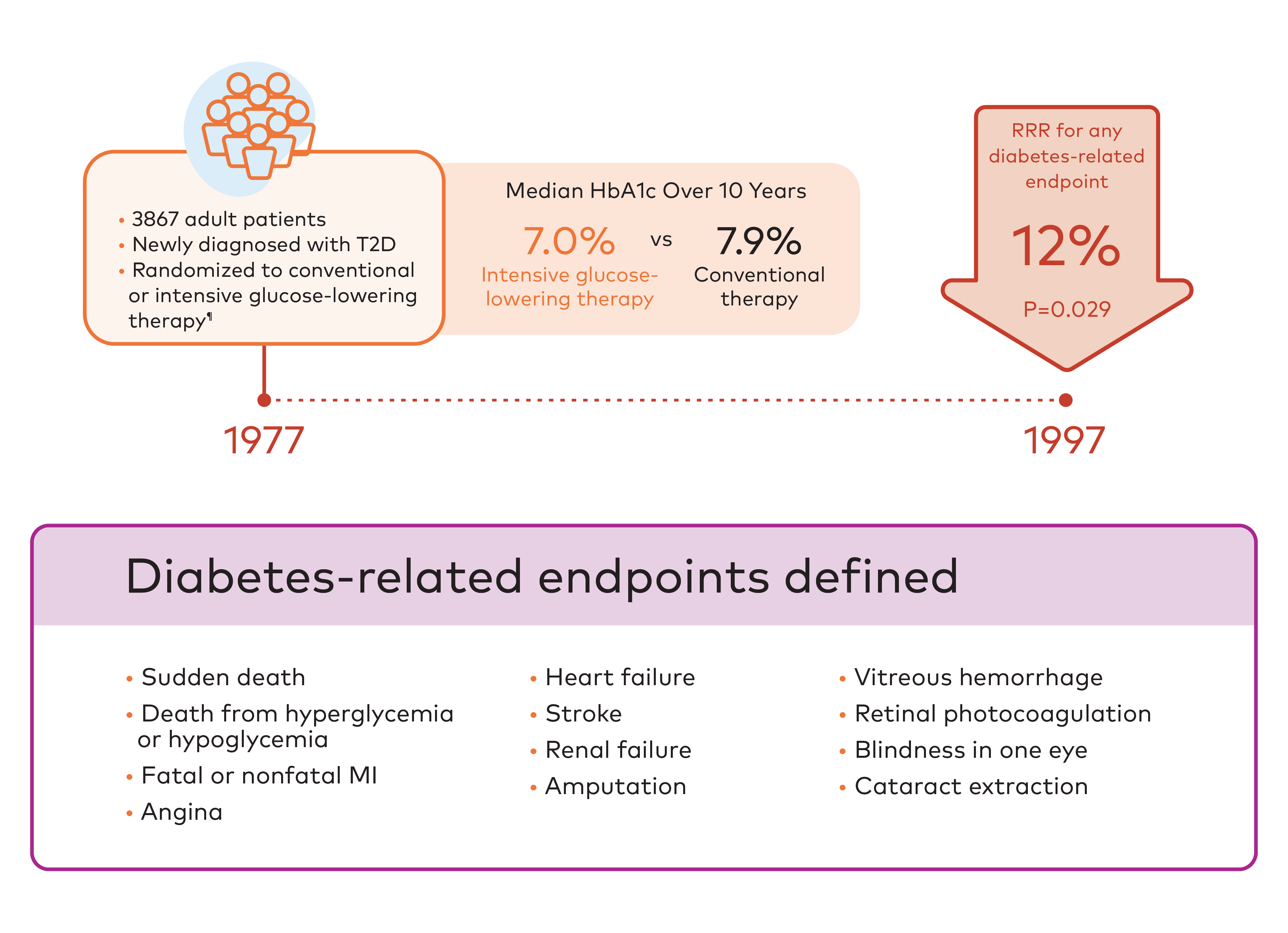
UKPDS: Design and results. 3867 patients newly diagnosed with type 2 diabetes were randomly assigned between 1977 and 1991 to an intensive regimen or a conventional diet regimen. In patients with the intensive regimen, a median HbA1c value of 7.0% was maintained over 10 years. In contrast, the HbA1c value of the control group was a higher median value of 7.9%. Early intensive glycaemic control resulted in a 12% lower risk of diabetes-related endpoints (sudden death, death from hyper- or hypoglycaemia, fatal or non-fatal myocardial infarction, angina, heart failure, stroke, renal failure, amputation, vitreous hemorrhage, retinal photocoagulation, blindness of one eye, cataract surgery).
Glycemic control defined as achieving HbA1c <7%.1
|| UKPDS was designed to establish whether intensive blood glucose control reduced the risk of vascular complications. Between 1977 and 1991, 3867 eligible participants (newly diagnosed with diabetes, 25 to 65 years of age, with an FPG level >6 mmol/L on 2 mornings, 1-3 weeks apart) were randomly assigned to an intensive policy with treatment or a conventional policy with diet.2,4
¶Conventional therapy defined as diet modification only. Intensive therapy defined as sulfonylurea or insulin or—in patients >120% of ideal body weight—metformin. In the intensive group, target FPG was <6 mmol/L, while in the conventional group the aim was the best achievable FPG with diet alone; drugs were added or titrated for the intensive group when above target, while rescue drugs were added to the conventional group only if there were hyperglycemic symptoms or FPG >15 mmol/L.2
Early glycemic control from the time of diagnosis had a greater impact on long-term benefits2,4
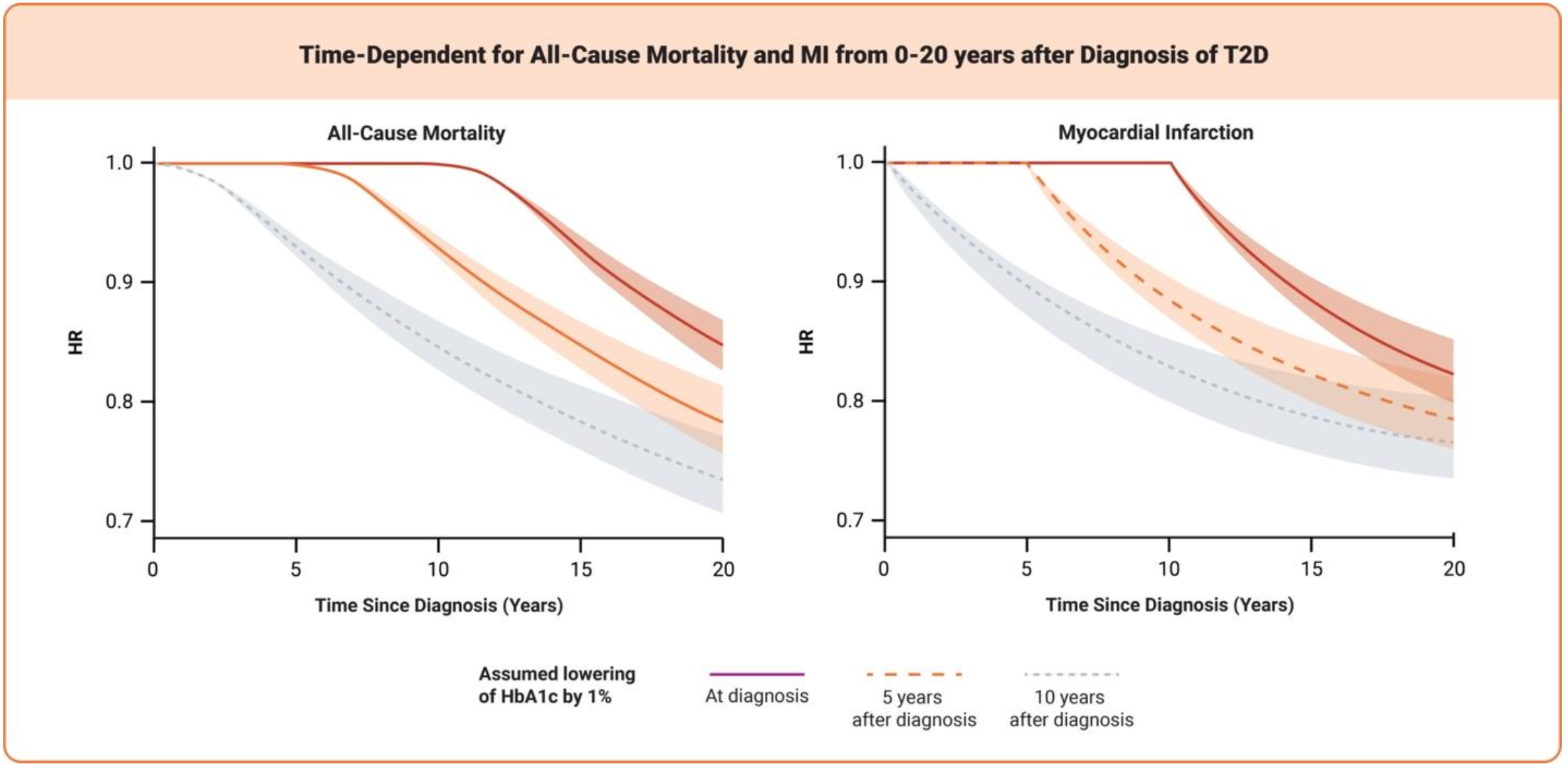
The line graphs show the hazard ratios for all-cause mortality and myocardial infarction as a function of time. With a 1% reduction in HbA1c, all-cause mortality and the risk of myocardial infarction are highest at diagnosis, lower 5 years after diagnosis, and lowest 10 years after diagnosis.

Results demonstrated a Legacy Effect, in which lowering HbA1c by 1% at the time of diagnosis had a greater impact on clinical outcomes than delayed control.4
When considering the UKPDS legacy data, a patient like Rahul who achieves early glycemic control with a proactive treatment approach is more likely to have a lower risk of T2D complications.2,5

ADA-EASD Consensus Report1:
“Among young adults with type 2 diabetes, immediate and sustained glycemic management should be pursued, aiming for HbA1c <53 mmol/mol (7%) (or even lower). This presents the best opportunity to avoid complications of diabetes across the lifespan.”
What Could Early Treatment Intensification Mean for Rahul’s T2D Management?
After early treatment intensification with a medication that had high to very high efficacy for both glycemic lowering and weight management, Rahul achieved his glycemic and weight loss goals and maintained them through his 1-year follow-up. His early success meant that he had the potential to reduce the risk of developing irreversible complications of T2D.1,6,7
Now, 10 years later, you’ve continued to treat Rahul, and he has remained committed to managing his T2D#

| 10 Years later4,10 | |
|---|---|
Rahul has the potential to reduce his risk of developing microvascular complications, such as**: | Retinopathy |
| Neuropathy | |
| Nephropathy | |
He may also reduce his risk of developing macrovascular complications, such as**: | Ischemic heart disease |
| Peripheral vascular disease | |
| Cerebrovascular disease |
#Hypothetical patient profile
**Based on outcomes observed in UKPDS and the Diabetes and Aging study. Additional research is needed to confirm these outcomes in newer medication classes.2,5,8
Considering medications with high to very high efficacy for glucose lowering and weight loss earlier can help patients achieve their goals sooner and avoid long-term complications.1
Let's review key points for a patient like Rahul from the ADA/EASD Consensus Report:
- More effective therapies with a low risk of hypoglycemia can be considered in addition to or instead of metformin from the start of T2D management1,9,10
- Weight management is a central focus in T2D management, and for patients with excess weight, consider medications with high or very high efficacy for glycemic control and weight management as adjuncts to lifestyle intervention1
- To avoid therapeutic inertia, reassess progress and modify treatment every 3 months if not at goal, monitoring every 6 months once goals are achieved1,9
- Achieving glycemic targets (7% or less) early after diagnosis yields substantial and enduring reductions in the onset and progression of microvascular complications1
Davies MJ, Aroda VR, Collins BS, et al. Management of hyperglycemia in type 2 diabetes, 2022. A consensus report by the American Diabetes Association (ADA) and the European Association for the Study of Diabetes (EASD). Diabetes Care. 2022;45(11):2753-2786. doi:10.2337/dci22-0034
UK Prospective Diabetes Study Group. Intensive blood-glucose control with sulphonylureas or insulin compared with conventional treatment and risk of complications in patients with type 2 diabetes (UKPDS 33). Lancet. 1998;352(9131):837-853. doi:10.1016/S0140-6736(98)07019-6
Holman RR, Paul SK, Bethel MA, et al. 10-year follow-up of intensive glucose control in type 2 diabetes. N Engl J Med. 2008;359(15):1577-1589. doi:10.1056/NEJMoa0806470
Lind M, Imberg H, Coleman RL, et al. Historical HbA1c values may explain the type 2 diabetes legacy effect: UKPDS 88. Diabetes Care. 2021;44(10):2231-2237. doi:10.2337/dc20-2439
Matthews D, Del Prato S, Mohan V, et al. Insights from VERIFY: early combination therapy provides better glycaemic durability than a stepwise approach in newly diagnosed type 2 diabetes. Diabetes Ther. 2020;11(11):2465-2476.oi:10.1007/s13300-020-00926-7
Schwartz SS, Epstein S, Corkey BE, et al. The time is right for a new classification system for diabetes: rationale and implications of the β-cell-centric classification schema. Diabetes Care. 2016;39(2):179-186. doi:10.2337/dc15-1585
DeFronzo RA. Banting Lecture. From the triumvirate to the ominous octet: a new paradigm for the treatment of type 2 diabetes mellitus. Diabetes. 2009;58(4):773-795. doi:10.2337/db09-9028
Laiteerapong N, Ham SA, Gao Y, et al. The legacy effect in type 2 diabetes: impact of early glycemic control on future complications (The Diabetes & Aging Study). Diabetes Care. 2019;42(3):416-426. doi:10.2337/dc17-1144
Campbell IW. Need for intensive, early glycemic control in patients with type 2 diabetes. J Brit Cardiol. 2000;7:625-631.
Holman RR, Paul SK, Bethel MA, et al. 10-year follow-up of intensive glucose control in type 2 diabetes. N Engl J Med. 2008;359(15):1577-1589. doi:10.1056/NEJMoa0806470